


It's tough seeing your dog in distress, full of fear and worry. The good news is that supplements for dogs with anxiety can offer a natural path to helping them feel more settled. These aren't sedatives designed to knock them out; instead, they use ingredients that work with your dog’s own body to gently encourage a sense of calm. Think of them as a helping hand for managing the stress from fireworks, being left alone, or just general nervousness.
Decoding Your Dog's Anxiety and How Supplements Can Help
When a dog is pacing, panting, or hiding, it's pretty obvious something's not right. But anxiety in dogs often starts with much quieter signals. Those subtle little cues—a lip lick when they aren't hungry, a yawn when they're not tired, or a sudden flash of the whites of their eyes—are the early whispers of stress. Spotting these is the first, most important step towards helping them. You can learn more about what to look for in our detailed guide on the signs of anxiety in dogs.
Anxiety isn't just one single thing; it shows up in a few different ways:
- Situational Anxiety: This is a direct reaction to a specific trigger, like the rumble of a thunderstorm, the motion of a car journey, or the overwhelming environment of a vet's office.
- Separation Anxiety: This is the deep distress a dog feels when they're left by themselves or separated from the person they're bonded to.
- Generalised Anxiety: This is a more persistent state of worry. The dog seems to be on edge all the time, without a clear, immediate cause.
Turning Down the Volume on Fear
Try to imagine your dog’s anxiety as a constant, low buzz of background noise. It's unsettling and makes it impossible to ever truly relax. Calming supplements work by helping to turn the volume down on that noise. They don't make the scary thing disappear, but they can take the edge off your dog’s reaction to it.
This helps create a calmer frame of mind, which makes your dog much more able to engage with training and other forms of behavioural support. A less anxious dog is a dog who can actually learn new, healthier ways to cope.
This is a really important point. Supplements aren't a quick fix or a magic pill. They are, however, a powerful part of your overall care plan. They work best when you combine them with positive reinforcement training, managing your dog's environment (like creating a cosy, safe den), and sticking to a predictable routine. The goal is never to change your dog's personality, but to give them the emotional foundation they need to feel safe and confident.
The Growing Need for Calming Support
As we've all become more in tune with our dogs' emotional lives, the search for effective, gentle support has grown. Many of us in the UK are now looking for calming aids to provide that extra comfort. Research backs this up, showing that around 50% of dogs in the UK are scared of fireworks and an estimated 15% struggle with separation anxiety. It's no wonder that supplements for dogs with anxiety have become such a vital part of modern pet care. This shift shows how much we've moved beyond just basic care and are now focusing on our dogs' mental well-being, too.
Exploring the Most Effective Calming Ingredients
Walking into a pet shop or browsing online for a calming supplement can be completely overwhelming. You're faced with dozens of tubs and packets, all promising a peaceful, happy dog. So, how do you cut through the noise and figure out what actually works?
The secret is to ignore the flashy packaging and focus on the active ingredients listed on the back. Each one works in a slightly different way to help your dog’s nervous system find its balance. Let’s look at the heavy hitters you’ll find in the best quality calming supplements.
This chart gives you a good overview of how we get from spotting anxiety signs to providing the right kind of support, like supplements.
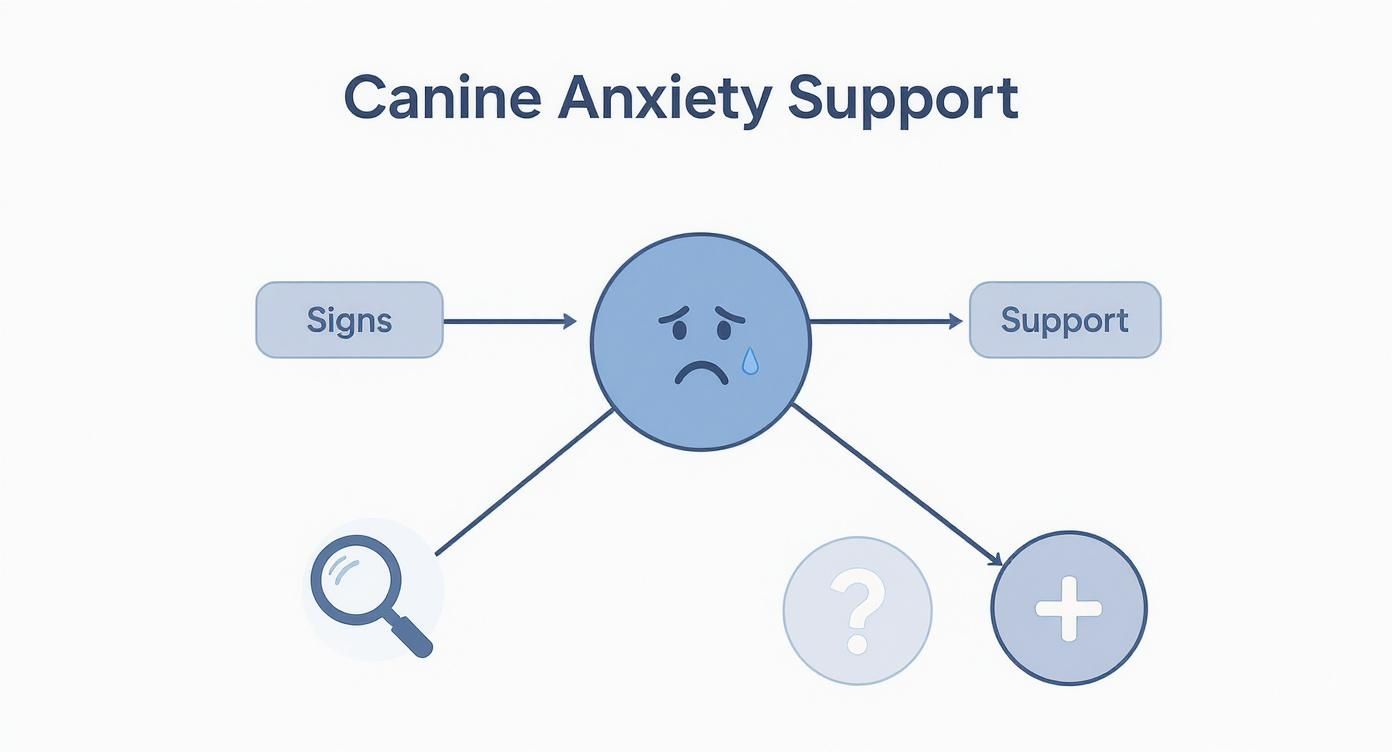
As you can see, supplements are a direct response to understanding what’s causing your dog’s distress in the first place.
Amino Acids: The Brain’s Mood Managers
You’ve probably heard of amino acids as the building blocks of protein, but some of them have a very specific job: managing mood. They are the raw ingredients the brain needs to make neurotransmitters – the chemical messengers that control everything from happiness to fear.
L-Tryptophan is the most famous of the bunch. It’s an essential amino acid that gets converted directly into serotonin. Think of serotonin as the brain's natural "it's all good" chemical. When serotonin levels are healthy, your dog feels more content and secure.
If serotonin dips too low, you often see more anxiety, grumpiness, or even obsessive behaviours. A supplement containing L-tryptophan simply gives the brain the materials it needs to top up those serotonin levels, helping to smooth out your dog's emotional rollercoaster.
L-Theanine, which comes from green tea, takes a different route. It helps boost the levels of other calming messengers in the brain, like GABA and dopamine. It also encourages alpha brain waves, which are linked to a state of ‘wakeful relaxation.’ This is perfect for situations where you want your dog to be calm but not sleepy, like when you have guests over or during a training class.
By working directly with the brain's own chemistry, amino acids like L-Tryptophan and L-Theanine get to the root of the problem. They don’t just sedate a dog; they support the very systems that regulate emotion.
This is why you'll find these two in so many top-tier calming formulas. They are fantastic for dogs with ongoing, generalised anxiety because they help create a more stable emotional baseline day-to-day.
Herbal Allies: Nature’s Gentle Touch
For thousands of years, people have turned to certain plants for their soothing effects, and they can work wonders for our dogs, too. These botanicals often provide a gentler, more subtle calming effect than pharmaceuticals, making them a brilliant choice for predictable, short-term stresses.
Here are a few of the most trusted herbal ingredients:
- Chamomile: It’s not just for sleepy-time tea! Chamomile contains a compound called apigenin, which works on brain receptors to gently reduce anxiety and encourage rest. It's a very mild herb, making it a great starting point for mild stress.
- Valerian Root: This one is a bit more powerful and is a go-to for acute anxiety, especially from loud noises like fireworks or thunderstorms. Valerian works by increasing GABA in the brain, which acts like a brake pedal on an over-excited nervous system.
- Passionflower: Often paired with Valerian, Passionflower also gives GABA levels a boost. The two work together to quieten down frantic brain activity, helping a restless dog to finally settle. It’s great for easing that pacing, can’t-get-comfy kind of anxiety.
These natural ingredients are the backbone of the market for supplements for dogs with anxiety. Market analysis from 2022 showed that calming supplements are a huge part of the industry, with local pet shops and supermarkets still accounting for a massive 88.7% of sales.
To help you quickly compare these popular options, here is a quick-reference table.
Comparing Common Calming Supplement Ingredients
| Ingredient | How It Works | Best For | Common Forms |
|---|---|---|---|
| L-Tryptophan | A building block for serotonin, the 'feel-good' neurotransmitter. | Generalised anxiety, mood stabilisation, daily stress. | Chews, powders, tablets |
| L-Theanine | Promotes 'wakeful relaxation' by boosting GABA and dopamine. | Situational stress (visitors, travel), focus during training. | Chews, liquids, tablets |
| Chamomile | Contains apigenin, which binds to brain receptors to induce calm. | Mild stress, promoting sleep, settling an upset stomach. | Chews, powders, teas |
| Valerian Root | Increases GABA in the brain to inhibit nerve transmission. | Acute anxiety from loud noises (fireworks, storms). | Tablets, tinctures, chews |
| Passionflower | Boosts GABA levels to quieten excessive brain activity. | Restlessness, noise phobias, separation anxiety. | Tablets, tinctures, chews |
This table shows how different ingredients tackle anxiety from various angles, allowing you to find a more targeted solution for your dog's specific needs.
Choosing the Right Ingredients for Your Dog
So, which one is right for your dog? It all comes down to their individual personality and triggers. A dog who gets wound up by every little noise might benefit from a different blend than a dog who dreads car journeys.
Understanding what’s inside the supplement is your first, most important step. When you can match an ingredient’s function to your dog's behaviour, you’re in a much better position to provide support that genuinely helps them feel safer and more relaxed. If you're ready to look at specific products, our guide to calming treats for dogs is a great place to start.
Understanding CBD for Canine Anxiety
You’ve probably seen CBD products for pets popping up everywhere, from your local groomer to online boutiques. It’s become a massive trend, but with all the hype comes a lot of confusion. What exactly is it, and could it genuinely help your anxious dog? Let's cut through the noise.
First things first, let's get one crucial point straight: CBD (Cannabidiol) is not psychoactive. It comes from the hemp plant, a cousin of marijuana, but it's not the compound that causes a "high." That’s THC. A properly made CBD product for pets won't intoxicate your dog; it's designed to be purely therapeutic.
How CBD Actually Works in Your Dog's Body
So, how does CBD help create a sense of calm? The magic lies in your dog’s endocannabinoid system (ECS). Think of the ECS as a sort of internal balancing act, a master regulator that keeps things like mood, sleep, appetite, and stress responses ticking over nicely. Its main job is to maintain stability.
CBD doesn't just barge in and flip a switch. Instead, it interacts with this system, giving it a gentle nudge to work more efficiently. This support can help moderate feelings of fear and anxiety. When the ECS is in balance, your dog might find it easier to cope with whatever triggers them, whether it’s you leaving for work or the dreaded sound of fireworks.
Decoding CBD Product Labels
Once you start shopping around, you’ll run into a few key terms. Getting to grips with them is the first step to picking a quality product.
- Full-Spectrum CBD: This type is the whole package. It contains all the compounds found naturally in the hemp plant, including other cannabinoids, terpenes, and a tiny, legally-allowed amount of THC (in the UK, that's less than 0.2%). The theory is that these compounds work together in an "entourage effect," boosting the overall benefits.
- Broad-Spectrum CBD: This is almost identical to full-spectrum but with one key difference: the THC has been completely removed. It's a great middle-ground for owners who want the entourage effect but prefer to avoid THC altogether.
- CBD Isolate: As the name suggests, this is pure, isolated CBD. It’s 99% pure CBD, with all other plant bits and pieces stripped away, meaning zero THC. You won't get the entourage effect, but it's the most straightforward option if you only want to give your dog CBD.
The type of CBD you choose—full-spectrum, broad-spectrum, or isolate—can influence its effects. Discussing these options with your vet can help determine the most suitable choice for your dog's specific needs and sensitivities.
Which one is right? It really depends on your comfort level and, most importantly, your vet's advice. Some early evidence hints that the entourage effect from full- and broad-spectrum products might offer more well-rounded support for anxiety.
Safety and Legality in the UK
Here in the UK, the rules around CBD for animals are quite specific. Products have to be sold as supplements, not medicines, unless they have a very rare authorisation from the Veterinary Medicines Directorate (VMD). This means companies can't make direct medical claims, like saying their product "cures" anxiety.
Crucially, any CBD product sold in the UK must contain less than 1mg of THC per container. This is a non-negotiable legal and safety line. Always look for a product's lab reports, often called a Certificate of Analysis (COA), to double-check the THC content and ensure it's both safe and legal for your pet.
Before you even think about adding a CBD supplement to your dog's routine, a chat with your vet is absolutely essential. They can advise you on whether it’s a good fit for your dog’s situation, point you towards reputable brands, and make sure it won’t clash with any other medications. Your vet is your best partner in this journey.
How to Choose a Safe and High-Quality Supplement

The market for supplements for dogs with anxiety has exploded, but with all that choice comes a bit of a minefield. You have to be a careful shopper because not all products are created equal. Choosing a poor-quality supplement isn't just a waste of money—it could be genuinely harmful to your dog.
Your best defence is to become a savvy consumer. It all starts with learning to read the label like a pro, looking right past the flashy marketing on the front to the nitty-gritty details on the back. That's where the real story is.
Read the Label Like an Expert
A good supplement label should be completely transparent, telling you everything you need to know. Think of it like reading a food label for yourself—you want to see clear, recognisable ingredients, not a long list of chemical fillers.
When you've got a product in your hand, here's what to zero in on:
- Active Ingredients: The label must clearly list what the active ingredients are (like L-tryptophan or chamomile) and state the exact amount in each serving. Be wary of vague terms like "proprietary blend," which can be a red flag used to hide the precise quantities of what's inside.
- Inactive Ingredients: Take a close look at what else is in the product. You want to see natural, wholesome ingredients, not artificial preservatives, colours, or flavours. Watch out for cheap fillers like corn and wheat, which offer no real benefit and can sometimes trigger sensitivities.
- Clear Dosage Instructions: The packaging should give you simple, easy-to-follow directions based on your dog's weight. If the instructions are missing or confusing, it’s a sign that the product probably wasn't formulated with professional care.
A trustworthy brand wants you to be informed. They provide clear, detailed information because they're confident in their product's quality and have absolutely nothing to hide.
This initial label check is your first line of defence. It helps you quickly weed out the low-quality options and focus on brands that actually prioritise your dog's well-being.
Look for Proof of Quality
Words on a label are one thing; proof is something else entirely. The most reputable brands will go the extra mile to have their products' safety and purity verified by independent labs.
This is where a Certificate of Analysis (COA) becomes your best friend. A COA is an official document from an independent, third-party laboratory that confirms the product meets its own specifications. It’s your guarantee that what's on the label is actually what's in the bottle.
A proper COA will verify two crucial things:
- Potency: It confirms that the amount of each active ingredient is accurate.
- Purity: It screens for nasty contaminants like heavy metals, pesticides, and microbes.
Good brands often make their COAs easy to find on their website, sometimes even linking to them via a QR code on the packaging. If you can't find it, don't be afraid to contact the company and ask. Any brand that seems reluctant to share this information should be viewed with a healthy dose of suspicion.
If you want to dig deeper into this, we've got you covered in our complete guide on selecting a calming supplement for dogs.
Always Involve Your Veterinarian
Finally, and this is the most critical step, always have a chat with your vet before starting any new supplement. Your vet is your most valuable partner in managing your dog's health.
They know your dog's entire medical history, including any current health conditions or medications. This is vital because even natural supplements can sometimes interact with prescription drugs or might not be suitable for dogs with certain health issues.
When you go for your appointment, bring the supplement you're considering with you, or at least have a clear photo of the label and ingredients list. This lets your vet give everything a proper look-over to make sure it’s a safe and sensible choice for your individual dog. This teamwork approach is the best way to ensure you're making a confident, well-informed decision for your furry family member.
Pairing Supplements with Effective Behaviour Training
Giving your dog a calming supplement without any training is a bit like handing a student a quiet library pass but forgetting to give them any books. The environment is certainly better, but the real work—the learning—hasn't even begun. Think of supplements for dogs with anxiety as a tool that makes effective training possible, not a magic pill that solves the problem on its own.
Here’s what’s really going on in your dog's head. Severe anxiety floods their brain with stress hormones, sending them straight into "fight or flight" mode. When they're in that state of panic, they simply can't learn anything new. Supplements can help lower that baseline of stress, creating a crucial window of opportunity where your dog is calm enough to actually listen, process what you're asking, and start building new, more positive associations.
This integrated approach—supplement plus training—is the gold standard for creating real, lasting change. The supplement helps create the calm, and the training then rewires their fearful response.
Putting the Partnership into Practice
So, what does this actually look like day-to-day? It’s all about being strategic and using the supplement to set your dog up for success before a training session even starts. This method works wonders for all sorts of anxiety triggers.
Let's look at a few real-world scenarios:
-
For Separation Anxiety: You might use a daily supplement to keep your dog's general stress levels down. With that foundation in place, you can start your gradual departure training—leaving for just 30 seconds, then a minute, then five—while your dog is calm enough to process that you always return and being alone isn't a catastrophe.
-
For Noise Phobias (like fireworks or storms): An hour or so before a storm is forecast to hit, you could give a fast-acting supplement. As it starts to work its magic, you can begin some gentle counter-conditioning. Try playing a recording of thunder at a barely audible volume while doling out their favourite, high-value treats. Your dog starts to connect that scary rumble with something amazing.
-
For Car Ride Anxiety: Giving a supplement 30-60 minutes before a planned trip can take the edge off their panic. This allows you to simply practise getting in and out of the car calmly, or even just taking a short, uneventful trip around the block. Without that overwhelming fear, the car can start to become just another boring, neutral place.
In every one of these examples, the supplement isn't the teacher. It’s the tool that turns your dog into a more capable and receptive student. This teamwork is what builds true resilience, giving your dog the coping skills they need for life.
The ultimate goal is to build your dog’s confidence so they can handle stressful situations on their own. Supplements open the door to this learning, and consistent, positive training walks them through it.
Knowing When to Call for Professional Help
While combining supplements and at-home training is a powerful strategy, some anxiety cases are just too complex or deeply rooted to tackle alone. If you feel like you're stuck and not seeing any progress, or if your dog's anxiety ever involves aggression, it's absolutely crucial to get professional guidance.
A Certified Professional Dog Trainer (CPDT) who specialises in anxiety, or even better, a Veterinary Behaviourist, can design a structured plan tailored specifically to your dog's needs. They have the expertise to help you nail advanced techniques like desensitisation and counter-conditioning with perfect timing and precision.
Think of a professional as a key member of your support team. They can properly assess the severity of your dog’s anxiety, recommend the right training protocols, and coordinate with your vet. This ensures that everything—supplements, training, and even prescription medications if needed—is working together seamlessly. This collaborative approach gives your dog the absolute best chance at living a calm and happy life.
Answering Your Questions About Anxiety Supplements
Dipping your toes into the world of anxiety supplements for your dog can feel a bit overwhelming. You're trying to do the best for your companion, but it's totally normal to have a few questions. To help you feel more confident, we've put together some straightforward answers to the queries we hear most often from dog owners just like you.
Think of this as your go-to guide for the common "what ifs" and "how longs". Let's get you the information you need to help your dog on their journey to a calmer, happier state of mind.
How Long Until I See Results?
This is the big one, isn't it? The honest answer is: it depends. It really comes down to the type of supplement you're using and the kind of anxiety your dog is dealing with. A good way to think about it is to split them into two camps: the sprinters and the marathon runners.
-
Fast-Acting Formulas: These are your sprinters, designed for specific, predictable stressful moments. Ingredients like Valerian Root or Passionflower are brilliant for this. You'd give them about 30 to 60 minutes before a known trigger—think a car trip or the rumble of an approaching thunderstorm. The calming effects kick in within an hour or so, but they don't last all day.
-
Daily Support Supplements: These are the marathon runners, built for managing that more constant, underlying anxiety. Formulas based on amino acids like L-tryptophan need a bit of time to build up in your dog's system. They work by gently supporting the brain's natural chemistry, which doesn't happen overnight. For these, you'll likely need to wait four to six weeks of consistent, daily use before you spot a real shift in their overall mood.
A little patience goes a long way, especially with daily supplements. You’re aiming for a steady improvement in how your dog copes with life, not an instant fix. It can be a massive help to keep a simple diary of their behaviour; you'll be surprised at the small but significant progress you start to notice.
Can I Give My Dog Human Supplements?
I'll be direct here: the answer is an absolute and unwavering no. It might seem like a harmless, convenient shortcut to share your own chamomile capsules, but it can be incredibly dangerous for your dog. There are two huge reasons for this: toxic ingredients and wildly incorrect dosages.
First, many human supplements contain things that are perfectly fine for us but are poisonous to dogs. The most infamous culprit is xylitol, an artificial sweetener you'll find in everything from vitamins to sugar-free gum. For a dog, it can cause devastating liver failure and a catastrophic drop in blood sugar. Other ingredients like certain nuts or essential oils can be just as harmful.
Second, even if an ingredient is technically safe, the amount in a human product is completely wrong for a dog's body. A dog’s metabolism is a world away from ours, and veterinary formulas are carefully calculated for their specific weight and physiology. Giving them a human-sized dose is a fast track to an overdose, which can lead to all sorts of serious health problems. Always, always stick to products made just for dogs.
What Side Effects Should I Watch For?
Good-quality, natural supplements for dogs with anxiety are generally very safe with a low risk of side effects. That said, every dog is an individual. Just like us, they can react to things differently. Whenever you introduce something new, it’s just good practice to keep a closer eye on them for a little while.
If you do see any side effects, they are almost always mild and temporary. The most common things you might notice are:
- Lethargy or Drowsiness: Some calming ingredients might make your dog a bit sleepier than usual at first. This usually fades as their system gets used to the supplement.
- Mild Digestive Upset: A new addition to their diet can sometimes lead to a slightly upset tummy, maybe some looser stools or a bit of gas.
These little wobbles often sort themselves out in a few days. However, you should call your vet straight away if you see anything more serious, like vomiting, persistent diarrhoea, a loss of appetite, or any other worrying changes in their behaviour. When in doubt, your vet is always your best partner in keeping your dog safe and healthy.
Ready to provide your dog with safe, effective, and natural support? The calming chews from Tipaw are formulated by experts using 100% natural ingredients to help soothe anxiety and promote a sense of well-being. Discover the difference and help your dog live a happier, more relaxed life.


