


A dog joint supplement is essentially a nutritional boost designed to support cartilage, ease inflammation, and help keep your dog moving freely. It's a way to be proactive about your dog's mobility, especially for older dogs, very active breeds, or those known to have joint troubles.
Why Your Dog's Mobility Matters More Than You Think
It often starts with little things you might barely notice. A slight hesitation before jumping on the sofa. A bit of stiffness first thing in the morning. It's easy to chalk these up to your dog simply getting older, but they're often the first signs that their joints are feeling the strain.
For those of us who love our dogs, keeping that spark of joy alive is everything. A dog’s happiness is so tied to their ability to move without a second thought—the thrill of chasing a ball, the excitement of a new walking route, or even just curling up comfortably at your feet. When that freedom of movement starts to fade, a little piece of their personality can fade with it.
A Proactive Approach to Joint Care
This is where we're seeing a real shift in how vets and dog owners in the UK think about joint health. Rather than waiting for serious stiffness and pain to take hold, the focus is now on proactive care. A high-quality dog joint supplement isn't just for managing an existing problem; it's a powerful tool for prevention.
It helps to think of it like oiling a squeaky hinge. You wouldn't wait for the hinge to rust solid before doing something about it. You'd add a drop of oil now and then to keep it swinging smoothly for years. That's what a good joint supplement does for your dog's joints.
This preventive mindset is all about protecting your dog's joyful movement before it starts to decline. It’s particularly vital for dogs who are naturally more prone to joint wear and tear:
- Senior Dogs: As they get older, a dog's natural ability to repair cartilage slows right down, leaving them more susceptible to arthritis.
- Large Breeds: Think Labradors, German Shepherds, and Golden Retrievers. Their extra weight puts continuous pressure on their joints.
- Highly Active Dogs: If your dog lives for running, jumping, and playing, they're putting a lot of extra mileage on their joints, which can speed up wear.
- Breeds with Genetic Predispositions: Some breeds are simply more likely to develop conditions like hip dysplasia.
The Growing Importance of Joint Health
This focus on proactive canine wellness isn’t just a fad; it’s becoming a cornerstone of modern pet care. Here in the UK, joint health supplements make up a massive 28% of the entire pet dietary supplement market—the second-largest category. This huge demand shows just how important these products have become for the UK's over 13 million dog-owning households. For anyone interested in the numbers, you can find more data on the UK pet dietary supplement market on Future Market Insights.
Ultimately, this guide is here to give you the vet-informed knowledge you need. We'll break down the science behind the key ingredients and help you understand how to choose the best natural products—like Tipaw's vet-approved chews—to keep your dog comfortable and happy for the long haul.
The Building Blocks of an Effective Joint Supplement
Choosing a dog joint supplement can feel a bit overwhelming, especially when the label reads like a chemistry textbook. You’ll see terms like "glucosamine" and "chondroitin" thrown around, but what do they actually do for your dog? Let’s break down these core ingredients and translate the science into real-world benefits for your best mate’s mobility.
Think of a top-quality joint supplement not as one single magic bullet, but as a skilled construction crew working together on a single project: your dog's joints. Each member of this crew has a very specific job, and it’s their combined effort that keeps those joints strong, flexible, and comfortable.
Let's meet the key players.
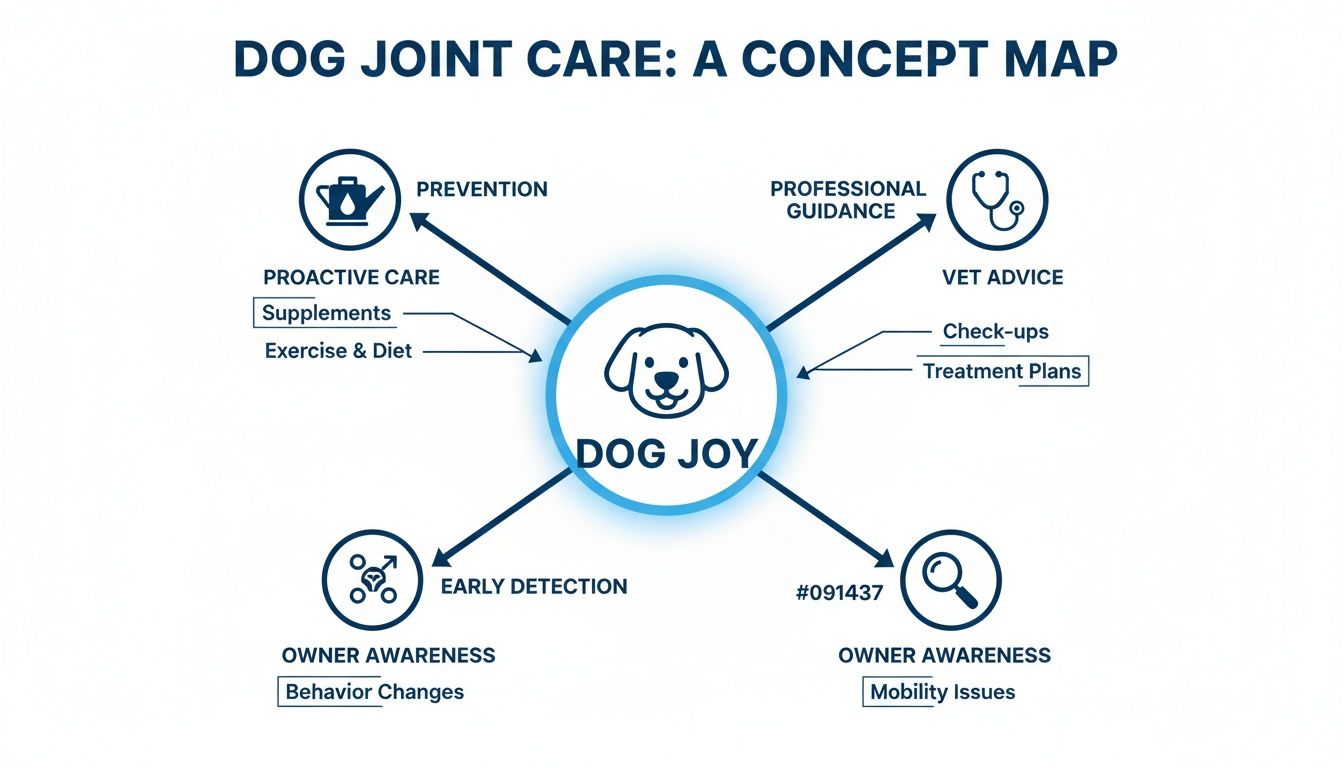
The main thing to remember is that a supplement is just one piece of the puzzle. It works best as part of a wider, more thoughtful approach to keeping your dog happy and on the move for years to come.
Key Ingredients in Dog Joint Supplements and Their Roles
To make sense of the label, it helps to understand who’s on the team and what role they play. This table breaks down the most important ingredients you'll find in a well-formulated chew.
| Ingredient | Primary Function (Analogy) | Best For |
|---|---|---|
| Glucosamine | The "Cartilage Repair Specialist" that patches up wear and tear. | Dogs with existing cartilage damage, seniors, and active breeds needing maintenance. |
| Chondroitin | The "Shock Absorber" that lubricates and cushions the joint. | Dogs needing impact protection, large breeds, and those with thinning cartilage. |
| MSM | The "Inflammation Soother" that provides natural pain relief. | Dogs showing signs of stiffness, soreness, or diagnosed with arthritis. |
| Omega-3s | The "System-Wide Firefighter" that reduces overall inflammation. | All dogs with joint issues, but especially those with widespread inflammatory conditions. |
| Collagen | The "Structural Scaffolding" that reinforces connective tissues. | Dogs needing to strengthen ligaments and tendons, and support cartilage integrity. |
| Hyaluronic Acid | The "Joint Oil" that ensures smooth, friction-free movement. | Older dogs with reduced joint fluid, or any dog needing extra lubrication. |
Together, these ingredients create a comprehensive support system, tackling joint health from every angle—from rebuilding tissue to providing much-needed comfort.
Glucosamine: The Cartilage Repair Specialist
Glucosamine is probably the most famous ingredient in the joint health world, and for good reason. It’s a naturally occurring compound that plays a central role in building and maintaining healthy cartilage—that smooth, rubbery tissue cushioning the ends of bones within a joint.
Picture cartilage as the smooth tarmac on a busy road. Over time, with constant traffic (or in a dog's case, all that running and jumping), potholes and cracks start to form. Glucosamine acts as the road repair crew, arriving on site with the raw materials needed to patch up these damaged spots and resurface the road.
By providing the fundamental building blocks for new cartilage, glucosamine helps to slow down the daily wear and tear that leads to stiffness and discomfort, especially in older dogs or very active breeds.
This is so important because a dog's body naturally produces less glucosamine as it gets older, making it much harder to keep up with repairs. Supplementing helps top up these levels, making sure the "repair crew" always has what it needs to get the job done.
Chondroitin: The Joint Shock Absorber
If glucosamine is the repair crew, then chondroitin is the joint's shock absorber and water magnet. It's another vital part of cartilage, and its main job is to draw fluid into the joint, which is essential for both lubrication and cushioning.
Think of chondroitin as a high-tech sponge woven directly into the cartilage. It soaks up water, giving the cartilage its spongy, shock-absorbing quality. This is what allows the joint to compress and rebound with every step, jump, or playful pounce, protecting the bones from jarring impacts.
On top of that, chondroitin helps to block certain destructive enzymes that can actually break down cartilage. It essentially puts up a defensive barrier, protecting the hard work the glucosamine "repair crew" has been doing.
MSM: The Natural Anti-Inflammatory
Methylsulfonylmethane, better known as MSM, is a natural sulphur compound with some impressive anti-inflammatory and pain-relieving properties. While glucosamine and chondroitin are focused on rebuilding and protecting the joint’s structure, MSM works to reduce the inflammation and soreness that so often come with joint problems.
You can think of MSM as the on-site medic for the joint. When a joint becomes stiff and achy because of inflammation, MSM helps to soothe the area, reduce swelling, and ease discomfort. This makes it far easier for your dog to move freely and can massively improve their quality of life, especially if they're already showing signs of arthritis. Its presence in a supplement formula provides more immediate comfort while the other ingredients get to work on long-term structural support.
The Supporting Cast: Omega-3s, Collagen, and Hyaluronic Acid
Beyond the "big three," a few other key players provide powerful, complementary benefits.
- Omega-3 Fatty Acids: Often sourced from fish or green-lipped mussels, these are nature's heavy-hitting anti-inflammatories. They work throughout the body to calm joint inflammation, much like MSM, but they do it through different biological pathways, offering a multi-pronged attack.
- Collagen: This is the main protein that forms the structural framework of cartilage, tendons, and ligaments. Adding collagen to their diet, especially a specific type called Undenatured Type II Collagen (UC-II), can help support the integrity and strength of all these important connective tissues. To learn more, check out our guide on collagen supplements for dogs.
- Hyaluronic Acid (HA): This is the star component of synovial fluid—the thick, slick liquid that lubricates the joint. Think of it as the engine oil for your dog's joints. HA is what ensures that smooth, gliding motion and is crucial for getting nutrients into the cartilage.
The demand for supplements with these effective ingredients is growing fast. The UK pet nutraceuticals market is expected to jump from £222 million in 2025 to a massive £355 million by 2030. This incredible growth is largely driven by the high prevalence of joint issues; data shows that 1 in 5 UK dogs over the age of eight suffers from osteoarthritis. It's clear that owners are increasingly looking for proactive ways to support their dogs' mobility and comfort.
Recognising the Dogs That Need Joint Support Most
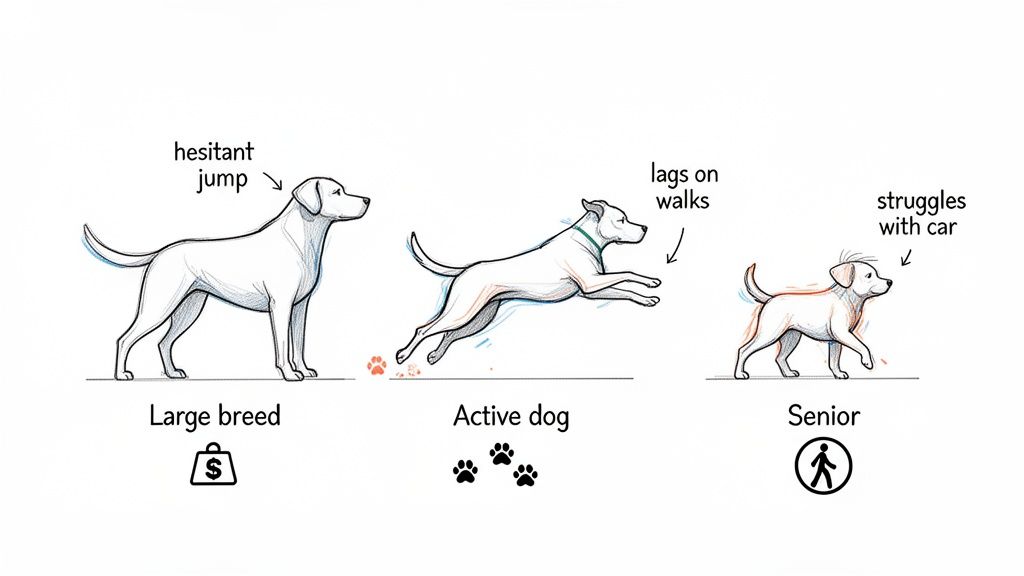
When you hear “dog joint supplement,” the first image that probably springs to mind is a grey-muzzled senior dog moving at a snail's pace. While older dogs are definitely prime candidates, this stereotype misses the bigger picture. Joint health isn't just an issue for the golden years; it’s a concern throughout a dog’s entire life.
Often, the first clues are subtle. You might notice a slight hesitation before they leap into the car, or maybe they start lagging behind on a walk they used to lead. Sometimes, it’s just that they seem a bit slower to get up after a nap. These aren't just signs of getting older—they're quiet signals that their joints are starting to feel the strain of daily life.
By learning to spot which dogs are most at risk, you can move from reacting to a problem to proactively preventing one. This means supporting their joints before real discomfort sets in, helping to protect their mobility and keep that spring in their step for years to come.
The Large Breed Profile
Large and giant breeds quite literally carry a heavier burden. Dogs like German Shepherds, Labradors, Great Danes, and Rottweilers are known to be more prone to joint conditions like hip and elbow dysplasia. Their sheer size and rapid puppy growth spurts put an enormous amount of stress on their developing skeletal framework.
Think of it like carrying a heavy rucksack every single day. Eventually, the strain would cause wear and tear on your own back and knees. For these bigger dogs, their own body weight has the same effect, speeding up the breakdown of cartilage. Starting them on a high-quality dog joint supplement early in their adult life provides the building blocks needed to reinforce their joints against this constant pressure.
The Canine Athlete Profile
Is your dog a furry ball of non-stop energy? I’m talking about the Border Collies herding imaginary sheep in the park, the Spaniels who live to retrieve, or any dog taking part in agility, flyball, or canicross. These four-legged athletes put some serious mileage on their joints with all that high-impact running, jumping, and sharp turning.
This constant, intense activity is no different to that of a human athlete. A marathon runner takes care of their knees, and in the same way, these active dogs need extra support to handle the stress on their cartilage and connective tissues. A good supplement can help maintain joint lubrication and cool down the exercise-induced inflammation that can lead to long-term damage, keeping them at the top of their game.
Just because a young, active dog isn't showing signs of slowing down doesn't mean their joints aren't under strain. Proactive support is about preserving that incredible athleticism for as long as possible.
Other Key Candidates for Joint Support
It’s not just the big dogs and the sporty ones. Several other groups can get a real boost from targeted joint care, and it’s important to make sure no dog gets overlooked.
- Overweight Dogs: Carrying even a few extra pounds puts a huge amount of extra load on a dog’s joints, particularly their hips and knees. While diet and exercise are the absolute priority, a supplement offers vital protection for their overworked joints as they work towards a healthier weight.
- Dogs Recovering from Injury: If a dog has had a joint-related injury, like a ligament tear or a fracture, that joint can become unstable and is more likely to develop arthritis down the line. Supplements can help the recovery process by managing inflammation and supporting tissue repair.
- Breeds with Unique Structures: It’s not just about size. Dogs with unique body shapes are also at risk. Think of Dachshunds with their long spines or Bulldogs with their stout, compact frames—their conformation makes them susceptible to specific joint and back problems.
Ultimately, nothing beats being an observant owner. Learning to spot the early signs of arthritis in dogs can make all the difference. When you catch these things early, you can step in with supportive measures like a dog joint supplement to help manage discomfort and slow down the progression of joint disease, ensuring your best mate stays happy, comfortable, and active.
How to Choose a Dog Joint Supplement That Actually Works
Walk into any pet shop or scroll online, and you’re hit with a wall of options for dog joint supplements. It’s overwhelming. With so many tubs and packets promising the world, how can you tell which ones are genuinely effective and which are just clever marketing?
Don't worry, picking a great supplement isn't as complicated as it seems once you know the right things to look for. Think of it like choosing a trusted mechanic. You wouldn’t go for the one with the biggest, flashiest sign; you’d look for certified experts who use quality parts and have a solid reputation. We'll apply that same logic to find the best support for your dog's long-term mobility.
Read the Label Like a Pro
The product label is your best friend here. A high-quality supplement brand has nothing to hide; they’ll be transparent with clear, detailed information. If a label is vague or uses "proprietary blends" to hide the exact amount of each ingredient, that's a red flag.
Here's a quick checklist for what a trustworthy label should have:
- Clear Amounts of Active Ingredients: It should state precisely how many milligrams (mg) of glucosamine, chondroitin, MSM, and other key components are in each serving or chew. No guesswork.
- A Full Ingredient List: This includes the "inactive" ingredients, too. Keep an eye out for unnecessary fillers, artificial colours, or sugars that offer no health benefit.
- Manufacturing Standards: Look for mentions of quality control standards, like Good Manufacturing Practices (GMP). This tells you the product was made in a facility that takes quality seriously.
Look for Vet-Formulated Products and Quality Sourcing
One of the best signs of a reliable supplement is that it’s been formulated or approved by veterinarians. This means the ingredients and their dosages are grounded in scientific evidence and real-world clinical experience, not just passing fads. A vet-approved formula gives you confidence that the product is both safe and designed to be effective.
Just as important is where the ingredients actually come from. Good brands are proud of their sourcing. They use purified ingredients that are highly bioavailable—a fancy word that simply means they're in a form your dog's body can easily absorb and put to work. After all, an ingredient isn't much good if it just passes straight through their system.
The Bottom Line: A top-tier joint supplement isn’t just about what’s in it, but the quality and form of those ingredients. High bioavailability is key to making sure your dog gets the full benefit from every single chew.
The Delivery Method Matters
Even the most perfectly formulated supplement is useless if you can't get your dog to take it every day. The way you give the supplement—the delivery method—makes a huge difference. While tablets and powders are out there, many dog owners know the struggle of trying to hide them in food.
This is exactly why tasty soft chews have become a game-changer for so many. A palatable, easy-to-give chew turns supplement time from a daily chore into a welcome treat. That consistency is crucial for the ingredients to build up in your dog’s system and deliver the results you’re looking for.
Red Flags to Watch Out For
Just as there are signs of quality, there are definite red flags that should give you pause. Be a bit suspicious of any product that:
- Makes over-the-top "cure-all" claims.
- Uses vague terms like "joint support matrix" without listing specific ingredient amounts.
- Is packed with artificial flavours, colours, or preservatives.
- Lacks clear contact information or a professional brand presence.
Taking this careful approach is becoming the norm for UK dog owners, who are increasingly focused on preventative joint care. In fact, 39.4% of European dog supplement buyers are now using them proactively to keep their dogs comfortable long-term. With the UK market making up 28% of all joint health sales in Europe, this has led to better oversight and higher-quality products—and a 49.6% repeat purchase rate shows that owners are finding supplements they can truly trust. You can dive deeper into these trends by exploring the latest dog supplement market analysis on Market Growth Reports.
This is why products like Tipaw's natural, science-backed chews have been developed—to meet these high standards and give conscientious owners a reliable, effective choice.
How to Give Supplements and Track Your Dog's Progress
So, you’ve done your research and picked out a great dog joint supplement. That’s a fantastic first step, but the real magic lies in consistency. Making the supplement a non-negotiable part of your dog's daily routine is how you'll see the best results.
Think of it like this: the powerful ingredients, whether it's glucosamine or omega-3s, need time to get to work. They don't provide instant relief. Instead, they gradually build up in your dog’s system to help soothe inflammation, lubricate joints, and support cartilage repair.
While you might spot a little more spring in their step within a few weeks, it typically takes six to eight weeks to see the full, most noticeable benefits. So, be patient and stick with it. Giving the chew at the same time every day—maybe as a special treat after breakfast—is a brilliant way to build a positive habit for you both.
The Power of a Simple Mobility Journal
How will you know if it's actually working? The improvements can be so subtle and gradual that they're easy to miss day-to-day. This is where keeping a simple 'mobility journal' is an absolute game-changer.
You don't need a fancy diary for this; the notes app on your phone or a spare notebook works perfectly. The idea is to track the small shifts in your dog’s comfort and behaviour, which gives you real, tangible proof of their progress and something concrete to discuss with your vet.
Here’s an easy way to start:
-
Set a Baseline: Before you give the first supplement, spend a few minutes jotting down how your dog is doing right now. Are they stiff and creaky first thing in the morning? Do they hesitate before jumping on the sofa? How far do they get on a walk before they start to lag behind?
-
Do Weekly Check-ins: Pick one day a week to be your "check-in" day. Use a simple 1-to-5 rating scale to score a few key activities.
- Morning Stiffness: (1 = Very stiff and slow, 5 = Moves easily)
- Eagerness to Play: (1 = Not interested, 5 = Ready for anything)
- Post-Walk Comfort: (1 = Obvious soreness or limping, 5 = Perfectly fine)
- Jumping Ability: (e.g., into the car) (1 = Can't or won't do it, 5 = Jumps up with ease)
-
Jot Down the Little Wins: Besides the scores, note down any specific observations. Did they run after a ball for the first time in ages? Did they greet you at the door with more enthusiasm? Did they get up from a nap without that familiar groan? These are often the most telling signs.
Keeping a journal does more than just chart progress. It empowers you. When you next see your vet, you can go beyond saying, "I think he's doing a bit better," and offer specific insights like, "Over the past six weeks, his morning stiffness score has gone from a 2 to a 4."
This simple habit helps you see that the dog joint supplement is truly making a difference. More importantly, it deepens your bond by tuning you into the nuances of your dog's health and happiness.
Beyond Supplements: A Holistic Approach to Joint Health
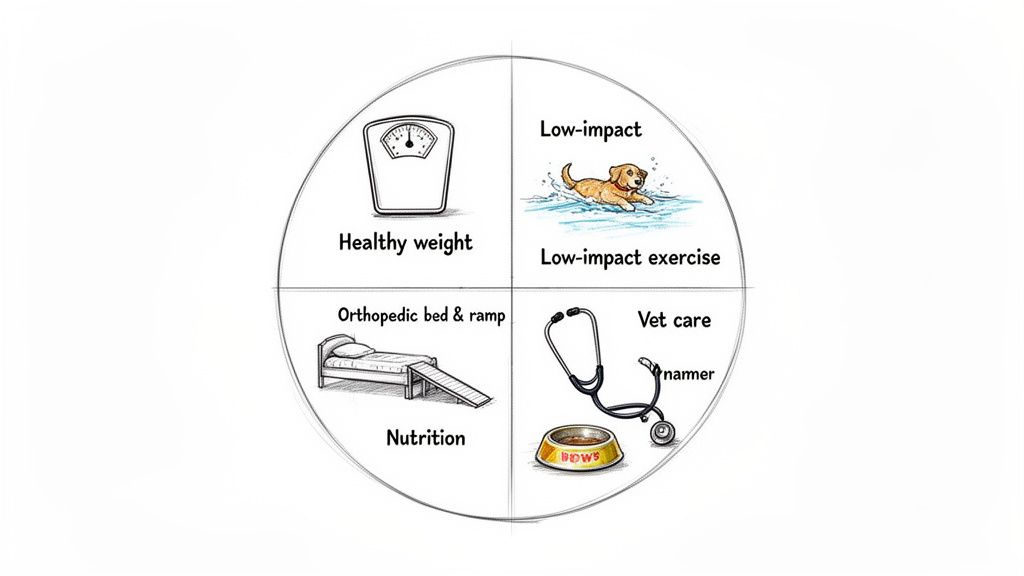
A high-quality dog joint supplement is a brilliant cornerstone for supporting mobility, but it works best when it’s part of a bigger picture. Think of it as one essential tool in a much larger toolkit for keeping your dog comfortable and active.
The other tools in this kit are all about your dog’s daily life, and they can make a massive difference. By pairing smart supplementation with these healthy habits, you create an environment that protects their joints from every angle, truly boosting their quality of life.
The Power of Maintaining a Healthy Weight
If you do just one thing to protect your dog’s joints, make it this: keep them at a healthy weight. Vets are unanimous on this point—it’s the single most impactful step you can take. Every extra pound your dog carries puts a compounding amount of stress on their hips, knees, and spine.
It’s like being forced to carry a heavy rucksack on every single step, all day long. That constant strain is immense. For a dog, even a small amount of excess weight creates this same relentless pressure, which speeds up cartilage wear and fuels inflammation. Getting their diet and weight right is fundamental to long-term joint health.
For dogs with joint issues, weight management isn't just a helpful tip; it's a non-negotiable part of their care plan. The relief a lean body provides far surpasses what any single supplement can achieve on its own.
Low-Impact Exercise and Home Comforts
Keeping your dog active is crucial, but the type of activity really matters. High-impact exercises, like frantic ball chasing or jumping, can be jarring on sensitive joints. The key is to focus on low-impact activities that build supporting muscle without the stress.
- Swimming: This is the gold standard of joint-friendly exercise. The water supports your dog’s body weight, allowing them to build strength without any harsh impact.
- Gentle Walks: Consistent, leisurely walks on softer surfaces like grass or trails are far better than intense, sporadic runs on hard pavement.
A few simple adjustments around the house can also provide immense relief and comfort:
- Orthopaedic Beds: A properly supportive bed cushions sore joints, promotes alignment, and ensures your dog gets genuinely restorative rest.
- Ramps: Placing ramps for getting into the car or onto the sofa prevents the painful jolt of jumping down.
This well-rounded approach is always the best strategy. To learn more about combining these lifestyle changes for long-term joint care, explore our complete guide on how to prevent arthritis in dogs.
Your Questions Answered: Dog Joint Supplements FAQ
It's natural to have questions when you're looking into your dog's health. And when it comes to something as vital as their mobility, you want straightforward, reliable answers. Here, we tackle the most common queries we hear from dog owners, giving you the clear, vet-informed advice you need to feel good about your decisions.
We've pulled together the top concerns to help clear up any confusion and make sure you have all the information you need to support your dog's active life.
When’s the Best Age to Start Giving My Dog a Joint Supplement?
The honest answer is: it depends on your dog. If you have a large breed or one that’s known for joint problems—think Labradors, German Shepherds, or Golden Retrievers—many vets recommend starting them on a supplement proactively, often around their first birthday. This gives their joints extra support during their most active, high-impact years.
For most other dogs, a good time to start is when you notice the first subtle hints of stiffness, or as they start heading into their senior years. The golden rule here is that prevention is far easier and more effective than trying to manage a problem later on. Starting early is never a bad idea.
Are There Any Side Effects I Should Worry About?
Thankfully, good-quality supplements made with natural ingredients are incredibly safe for long-term use. The most common side effect, which is still quite rare, is a bit of tummy upset like loose stools. This usually just happens as your dog's digestive system gets used to something new.
Pro Tip: To sidestep any digestive issues, introduce the new supplement slowly over a week. If your dog has other health conditions or takes regular medication, a quick chat with your vet before starting is always the safest bet.
How Long Will It Take to See a Difference?
This is where patience and consistency really pay off. Joint supplements aren't a quick fix; they work steadily over time to replenish joint fluid, calm inflammation, and supply the building blocks for healthy cartilage. That process doesn't happen in a day.
Some owners tell us they see their dog moving more freely in as little as three to four weeks. However, it’s more typical to see the full, noticeable benefits after about six to eight weeks. Stick with it every day, and maybe even jot down notes on their mobility—you'll likely see small but meaningful improvements along the way.
Can My Dog Take Joint Supplements with Other Medications?
This is a really important question, and it's one for your vet. While most natural joint supplement formulas are perfectly safe to use alongside other treatments, including common pain relief like non-steroidal anti-inflammatory drugs (NSAIDs), only your vet knows your dog’s full health picture.
They can give you the definitive green light and make sure there are no risks of a bad interaction between the supplement and any prescriptions. Getting their professional advice ensures you're doing the absolute best for your dog's specific needs.
For a vet-approved, natural solution designed to support your dog’s joints and keep them moving comfortably, explore the functional chews from Tipaw. Discover our scientifically formulated supplements at https://www.store-tipaw.com.


